Website Design & Development
Frontera Materials' new site is live at fmitex.com
June 4, 2026 · 5 min read · MPC Studios
On a road job in the Rio Grande Valley, the costliest delay is often the simplest one: the material is late. A crew can be staged and ready, and the whole day stalls waiting on a load of asphalt that never showed. South Texas is in the middle of one of the busiest road-building stretches in its history, and the contractors doing that work depend on whether the material arrives, on spec, on the day they need it.
Frontera Materials has been answering that question for South Texas builders since 1988. The company runs its own quarries, caliche pits, and gravel pits across the Valley and supplies asphalt, aggregates, and caliche straight from those operations to job sites in the region. After a full rebuild, the new fmitex.com is live, now built on Next.js and organized around the decisions a contractor actually makes before placing an order.
Frontera's whole advantage is control. Because the company owns the quarries and pits the material comes from, it can promise a level of reliability and consistency that a reseller moving someone else's stone struggles to match. The website had to make that advantage obvious, and it had to answer three questions fast: what does Frontera supply, will they deliver to my county, and will the material meet the spec my project calls for. The previous site had served the company well for years, and Frontera has grown right alongside the Valley, so the site needed to grow with it.
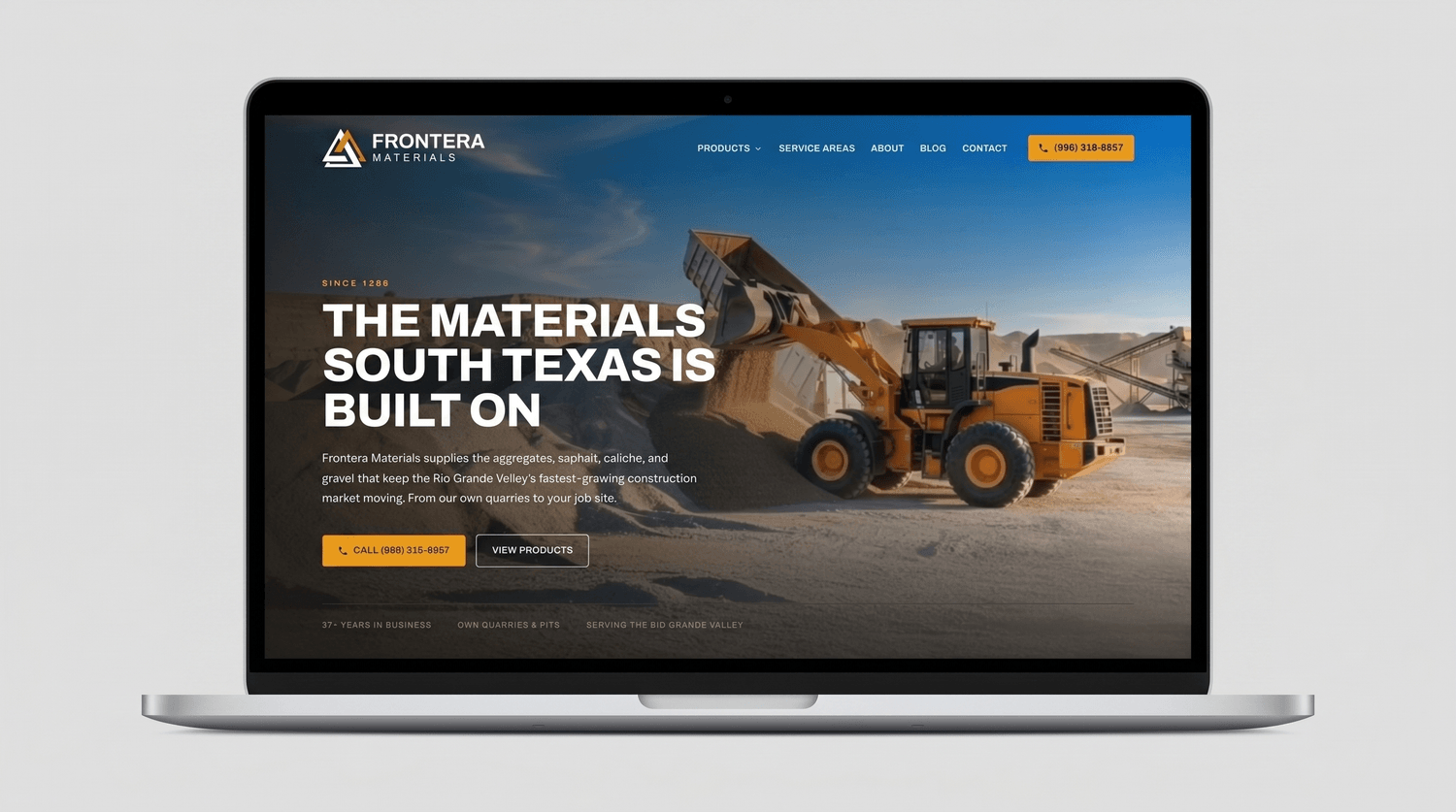
A homepage that answers the first question on sight
The homepage opens on a single line: "The materials South Texas is built on." Below it, "From our own quarries to your job site" sums up the company's model, and a phone number sits at the top of the page so a contractor who already knows what they need can place an order in one tap. For everyone still deciding, three product cards lead straight into the catalog.
That structure respects how this audience behaves. A project manager pricing a paving job is checking whether Frontera carries hot mix asphalt and whether it meets the state's material specs, then reaching for the phone. The homepage gets them to that answer in one scroll and keeps the call button within reach the whole way down.
Three product lines, each with a real home
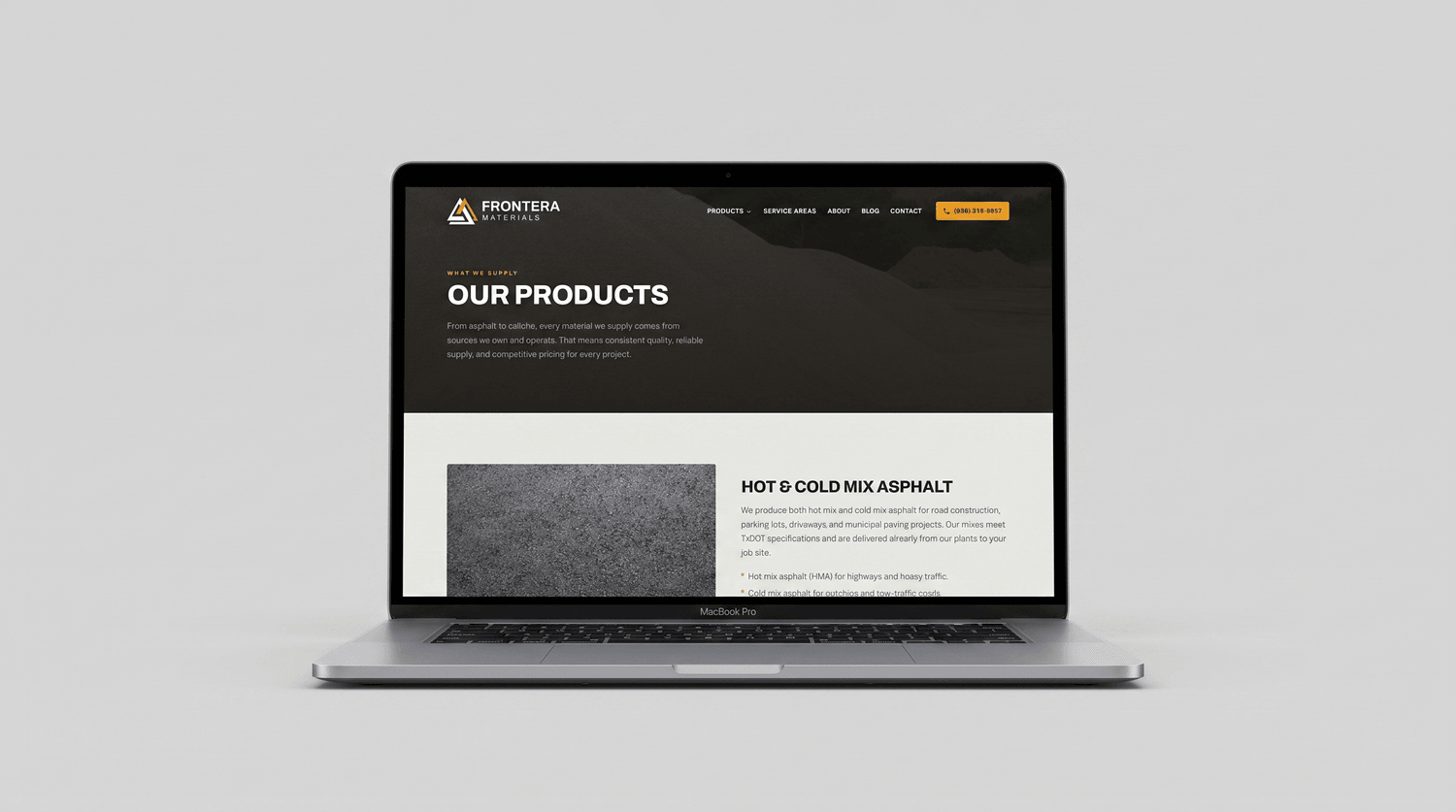
Frontera supplies three categories of material, and each now has a dedicated page with the detail a buyer needs to specify it.
- Hot & Cold Mix Asphalt. Hot mix asphalt for highways and heavy traffic, cold mix for patching and low-traffic roads, custom mix designs, and material built to TxDOT-approved specifications. (TxDOT is the Texas Department of Transportation, whose specs most public road work has to satisfy.)
- Aggregates & Gravel. Crushed limestone, base materials, and washed or unwashed gravel in a range of grades and sizes, all from Frontera's own quarries.
- Caliche. Called "a South Texas staple" on the site, used for road bases, fill material, lot preparation, and general site work.
For a spec-driven buyer, that level of detail is the difference between a confident order and a phone call to double-check. It also gives each material its own page for search, so a contractor Googling "cold mix asphalt" or "caliche supplier" in the Valley has a real chance of landing on Frontera rather than a generic directory.
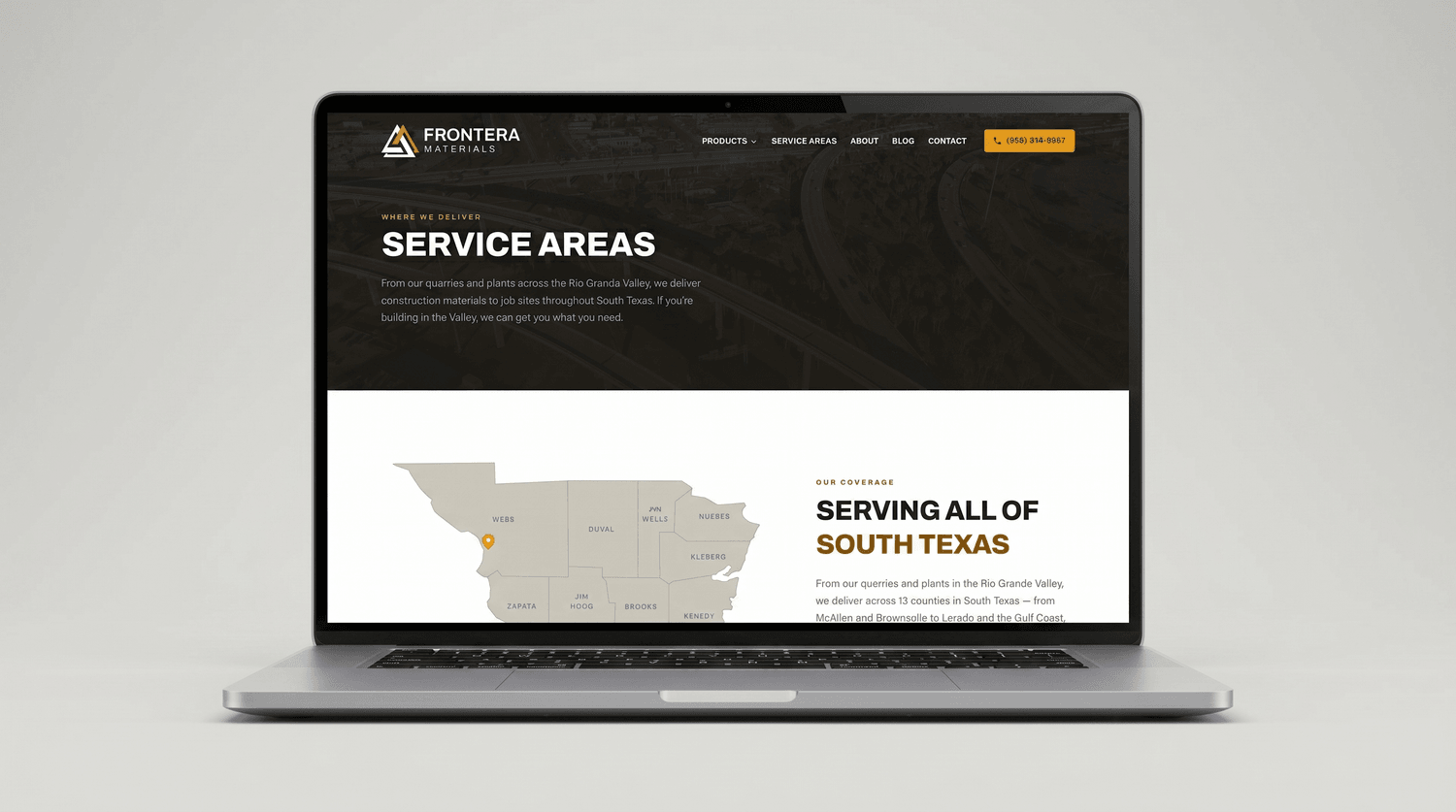
A service-area map built for "will you deliver to my job site?"
The question a new customer asks before anything else is whether Frontera even covers their location. The service-areas page answers it with an interactive map of the thirteen South Texas counties the company delivers to, reaching from Hidalgo and Cameron on the border up through Nueces on the Gulf Coast and west to Webb County around Laredo.
Eight of the Valley's busiest markets get their own detail cards, from McAllen and Edinburg in the heart of Hidalgo County to Brownsville and Harlingen near the coast and Laredo out west, so a contractor in any of them can confirm coverage and see what Frontera handles locally. The page is clear that the company takes on everything from single loads to long-term contracts, which tells a small paving outfit and a highway prime contractor alike that they're in the right place.
The timing matters. South Texas is in the middle of a building boom, and the state is funding it. The Texas Department of Transportation's latest ten-year plan commits more than $146 billion to transportation projects, the third year running that the plan has topped $100 billion. Closer to home, construction on the International Bridge Trade Corridor, a new freight route connecting Rio Grande Valley ports of entry to the interstate system, is set to begin in 2026 and run for roughly three years. Every one of those projects needs asphalt, base, and fill, and a supplier whose website makes coverage and capacity obvious is far easier to pull onto a bid.
From our own quarries to your job site
Frontera owns and runs the quarries and pits its material comes from, which is rare in this business. That vertical integration is the reason the company can stand behind its reliability and its consistency, and it's the story the about page now tells plainly.
Since 1988, the company has built its reputation on removing the layers between the ground and the job site. The new site puts that idea front and center: "100% materials from our own quarries and pits" is the organizing line of the whole page. When a contractor understands that the company controls the source, the promise of on-time delivery and consistent spec starts to sound like something Frontera can actually keep.
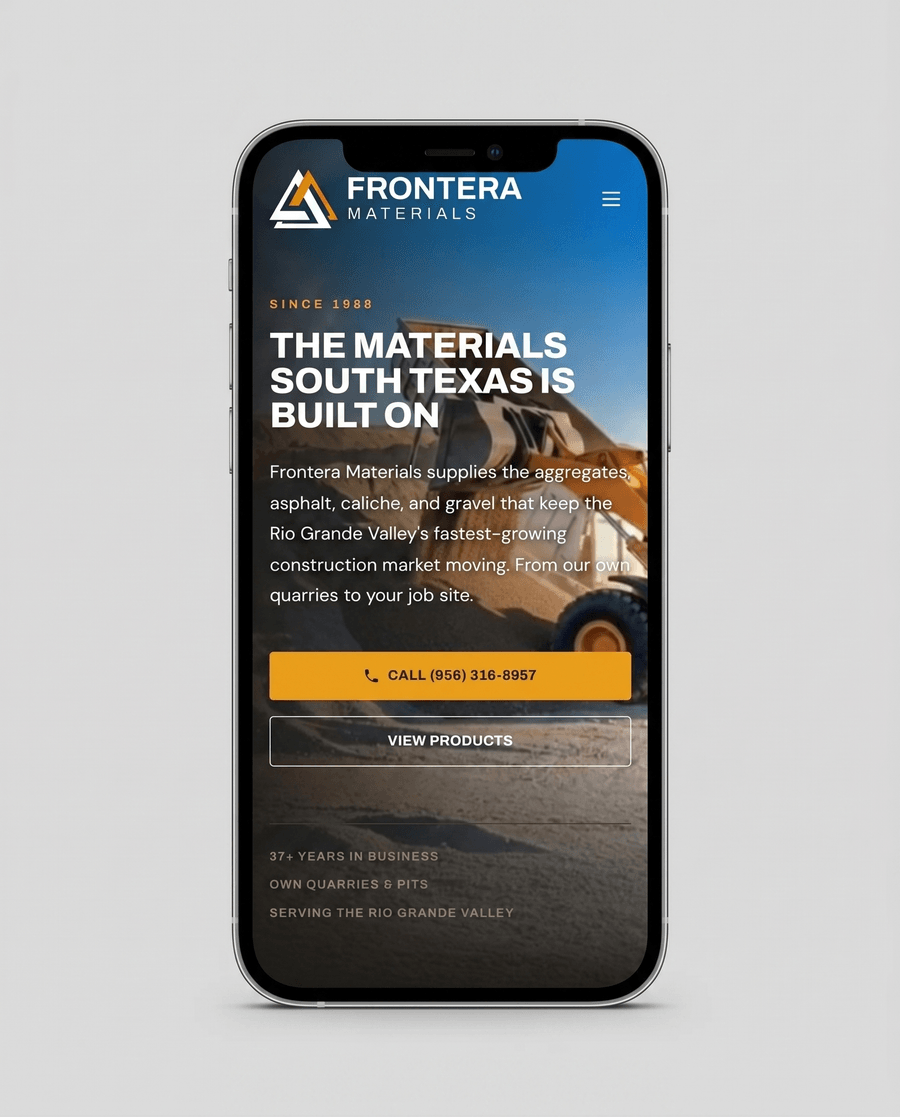
Rebuilt for speed and easy updates
A few notes for anyone weighing a similar rebuild:
- Built to load fast on a job-site phone. The site was rebuilt on Next.js, a current web framework, and tuned so pages load quickly on a phone with two bars of signal in a caliche pit. For an audience that's rarely sitting at a desk, that speed is most of the experience.
- The move off the old platform kept the company's search history intact. The previous site ran on WordPress, and the rebuild mapped its existing pages onto the new structure with redirects, so years of accumulated search ranking and any printed or saved links keep working.
- The Frontera team can update the site without calling a developer. Adding a product detail, a new service area, or a blog post happens through a simple editor, and the page comes out on-brand and mobile-ready on its own.
- AI took the grunt work so our designer could own the details. Claude handled much of the repetitive conversion and restructuring of the old site's content, which freed our creative director, Kate Hurry, to stay hands-on with the choices that shape how the site feels: the layout, the typography, and the small interactions a visitor actually notices. AI is one of several ways we build, and on this project it put more of the hours into design and craft.
What other suppliers can take from this
The most useful idea here reaches well beyond asphalt: organize the website around the sequence of decisions a buyer actually makes. For a materials supplier that sequence is what, where, to what spec, and how fast, so the site leads with products, coverage, and reliability and keeps the contact path one tap away. A business selling to professionals who are working under deadline should assume every visitor is mid-decision and make the next step obvious on every screen.
There's also a strong case here for letting structure do the selling. Frontera's real differentiator, owning its own quarries and pits, was always true, but a clearly organized site makes it legible to someone who has never set foot on one of those operations. The same goes for the breadth of coverage. Thirteen counties sounds abstract until a contractor sees their own city on a map with a card confirming that Frontera delivers there. Good information architecture, the unglamorous work of deciding what goes where and why, is often what turns a real-world advantage into one a customer can see before they ever pick up the phone.
Visit the new site at fmitex.com. If you run a materials business, a construction company, or any operation in South Texas whose website needs to keep pace with how fast the region is building, get in touch.
Let's work together
Ready to take your
business further?
Tell us about your project and let's create something extraordinary together.